|
The Argosy Players in: As long as they’re happy
by Vernon Sylvaine
Staged:
11 to 13 December 1958 at Crane theatre Hanover Street Liverpool

 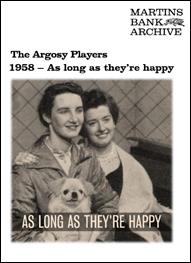 Time for
an uproarious farce, as the Argosy Players select “As Long as They’re Happy”
to warm up three winter evenings in December 1958. By now, the players have the experience to
be able to turn their hand to any kind of production, and are not afraid to
have a go – often to critical acclaim. In “As Long as They’re Happy”, one
actor is required to give an air of “spiviness AND effeminacy” and Martins Bank Magazine calculates that to do this
properly, he should have had a better costume than “just sports clothes to
disguise his manliness”! (Ooh
Matron!) We must remember that these
are times when everything from effeminacy to same sex relationships are
generally driven underground, hidden from the public’s view, and sadly of
course criminalised, with people ignorantly believing the wholly incorrect
stereotype that you can’t be gay and manly at the same time! The play includes a straight-laced father
railing against his daughters’ choice of men, an existentialist (?) a maid,
and a doctor with a German accent!
Also “one wild oat” is sown! It seems just about anything could happen
and probably, it does. All aboard then for this classic farce, reported for
us by Martins Bank Magazine’s Summer 1958 edition… Time for
an uproarious farce, as the Argosy Players select “As Long as They’re Happy”
to warm up three winter evenings in December 1958. By now, the players have the experience to
be able to turn their hand to any kind of production, and are not afraid to
have a go – often to critical acclaim. In “As Long as They’re Happy”, one
actor is required to give an air of “spiviness AND effeminacy” and Martins Bank Magazine calculates that to do this
properly, he should have had a better costume than “just sports clothes to
disguise his manliness”! (Ooh
Matron!) We must remember that these
are times when everything from effeminacy to same sex relationships are
generally driven underground, hidden from the public’s view, and sadly of
course criminalised, with people ignorantly believing the wholly incorrect
stereotype that you can’t be gay and manly at the same time! The play includes a straight-laced father
railing against his daughters’ choice of men, an existentialist (?) a maid,
and a doctor with a German accent!
Also “one wild oat” is sown! It seems just about anything could happen
and probably, it does. All aboard then for this classic farce, reported for
us by Martins Bank Magazine’s Summer 1958 edition…

|
 FOR their
December 1958 production the Argosy Players chose the well-known uproarious
farcical comedy in three acts As
Long As They’re Happy, by Vernon Sylvaine. They produced it on three
nights, 11th 12th and 13th December at Crane Theatre, Liverpool. The plot
concerns the trials of a strictly orthodox city business man whose
daughters fall in love with a crying crooner, an existentialist and a
cowboy respectively. The play
brought out some very good acting and it was refreshing to see one or two
of our more experienced members given their chance to prove themselves in
parts other than those in which we have been accustomed to see them. For
all-round excellence Norman Hubbard’s portrayal of the city man would be
hard to beat. He has an excellent speaking voice and his interpretation in
the later scenes of the behaviour of a slightly inebriated member of the
Stock Exchange was particularly convincing. The gradual transition from
being a model of stiff conventionality to the state of mind in which he
permits himself to sow one wild oat was very cleverly portrayed. FOR their
December 1958 production the Argosy Players chose the well-known uproarious
farcical comedy in three acts As
Long As They’re Happy, by Vernon Sylvaine. They produced it on three
nights, 11th 12th and 13th December at Crane Theatre, Liverpool. The plot
concerns the trials of a strictly orthodox city business man whose
daughters fall in love with a crying crooner, an existentialist and a
cowboy respectively. The play
brought out some very good acting and it was refreshing to see one or two
of our more experienced members given their chance to prove themselves in
parts other than those in which we have been accustomed to see them. For
all-round excellence Norman Hubbard’s portrayal of the city man would be
hard to beat. He has an excellent speaking voice and his interpretation in
the later scenes of the behaviour of a slightly inebriated member of the
Stock Exchange was particularly convincing. The gradual transition from
being a model of stiff conventionality to the state of mind in which he
permits himself to sow one wild oat was very cleverly portrayed.
|
|
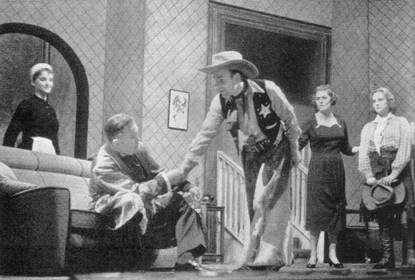
Brian
Isaac, Valerie Parish and Norman Hubbard
|
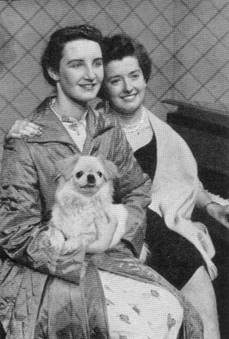
Valerie
Lever, Norman Hubbard, Ken Maddison, Maud
Melville and Diana Hamilton
|
|
Maud Melville, as the gushing wife, theatrical of voice and
gesture, perfectly offset the dry, matter-of-fact tones of her more prosaic
husband. It was a part which demanded continuous maintenance of effort
throughout the play and we did not detect a single lapse. It was a very
welcome change of type of part which was obviously very stimulating to her.
The three daughters were played by Valerie Tilley, Valerie Parish and Diana
Hamilton. Valerie Tilley as the girl who falls hopelessly in love with the
crying crooner was excellent, especially in the emotional scenes which can
be so wooden and artificial if they are not done well. For the time being
we got the impression that she is the type of girl who really would fall
for a crooner, which is a great tribute to her talent as an amateur
actress. She presented the picture of a young and inexperienced girl with
tremendous charm. Valerie Parish is a competent amateur with an excellent
voice and a good sense of theatre and she gave us a confident portrayal of
the wife of the existentialist. The portrayal was rather overpowering,
however, and she did not convince us that such a strong and balanced personality
would fall for the crackpot existentialist. Far and away her best portrayal
was in the scene where she reverts to her old self; a sweet and appealing
scene.
|
|

Marshall
Hesketh & Bill Brookes
|
So far as Diana Hamilton was concerned, as her appearance with Ken
Maddison came right at the end of the play, as a curtain, and only one
sentence was spoken, there is nothing we can say except that they both
looked their parts as the cowboy and cowgirl, as our photograph shows. An
unusually important part for a maid was played by Valerie Lever, another
mesmerised victim of the crying crooner. Every time he spoke to her, she
fainted. She did it extraordinarily well.
The crooner himself was played by Marshall Hesketh. In the difficult
scenes during which he has to sing and cry at the same time he was
magnificent, but costume was rather out of character and something more
than sports clothes seemed to be needed to disguise his manliness and
introduce an element of “spiviness”
and effeminacy. Or have we got the wrong idea about crooners ?
|
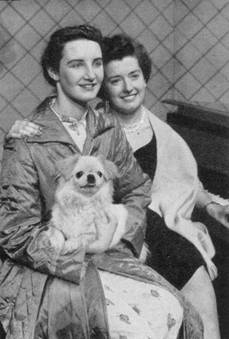
Valerie
Tilley & Valerie Barrett
|
|
|
|
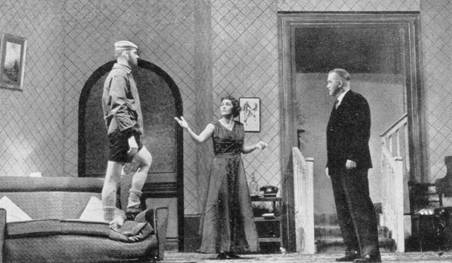
Brian
Isaacson, Maud Melville and Norman Hubbard
|
The doctor was played by Bill Brookes. Broken English with a German
accent was Bill's particular problem in a part which he portrayed well, but
at times he was almost inaudible.Full marks to
Brian Isaacson for the best performance, as the existentialist, which we
have seen him give. His portrayal was a pleasant breakaway from the dour,
somewhat heavy parts with which he has been typed too often. Valerie
Barrett played the part of the lady who has been engaged to entertain the
city man and help him to sow the wild oat already referred to. She was
appropriately gowned in a somewhat seductive dress and attention was drawn
to the rut into which the city man had allowed his ideas to get bogged down
by his failure to respond to the stimulus of her presence in the orthodox
manner. She certainly exercised charm.
|
|
The part of the news reporter was played by Bryan Isaac who chose
the quieter portrayal rather than that of the importunate news hawk. As a
result, he gained more sympathy from the audience than was probably the
intention of the playwright.The play was produced
by Sidney Costin, and a special word of thanks is due to Alan Mills for his
cheerful and untiring service as Stage Manager and to Audrey McPherson,
who, as prompter had no prompting to do at all, but who faithfully
performed this dull and exacting job and attended on every occasion when
she was needed.
|
|
|
|
|
|

Intellectual Property Rights © Martins Bank
Archive Collections 1988 to date.
|


