|

The Argosy Players in:
On Approval by Frederick Lonsdale
Staged: 09 to 11 December 1954 at Crane Theatre Hanover Street
Liverpool

  During its 23 years in print, Martins Bank Magazine does its best to
feature every single performance staged by the Bank’s various operatic and
dramatic societies. From occasional offerings by the Manchester Players and
the ArgoFor Players, to the full-blown musical extravaganzas staged by the
Operatic Society, we can be certain that good coverage will be given, and
that both bouquets and brickbats will be dished out in equal measure. Nothing gets past the Magazine’s
theatre-going correspondents, and from poor make-up to an outstanding stage
set or vocal performance, we are taken through reviews as if we had
accompanied the writer to the theatre ourselves. In Spring 1955, Martins Bank Magazine
reveals that it would usually review the Cicala and North Eastern Players on
the FIRST night of production, and the Argosy Players on the LAST. This is probably more to do with geography than anything
else, but seeing a play on its third performance means that many faults will
have already had the chance to be “ironed out”. For whatever reason, in the case of “On
Approval”, performed by the Argosy Players in 1954, the review was undertaken
on the first night – 9 December… During its 23 years in print, Martins Bank Magazine does its best to
feature every single performance staged by the Bank’s various operatic and
dramatic societies. From occasional offerings by the Manchester Players and
the ArgoFor Players, to the full-blown musical extravaganzas staged by the
Operatic Society, we can be certain that good coverage will be given, and
that both bouquets and brickbats will be dished out in equal measure. Nothing gets past the Magazine’s
theatre-going correspondents, and from poor make-up to an outstanding stage
set or vocal performance, we are taken through reviews as if we had
accompanied the writer to the theatre ourselves. In Spring 1955, Martins Bank Magazine
reveals that it would usually review the Cicala and North Eastern Players on
the FIRST night of production, and the Argosy Players on the LAST. This is probably more to do with geography than anything
else, but seeing a play on its third performance means that many faults will
have already had the chance to be “ironed out”. For whatever reason, in the case of “On
Approval”, performed by the Argosy Players in 1954, the review was undertaken
on the first night – 9 December…
|
 We have commented before on
the turn of events which usually forces us to visit the Cicala Players and
the North Eastern Players on the first night of their productions, whereas
we usually manage to visit the Argosy Players on the last night, when
things are as near perfection as it is possible for them to be. However, on
the occasion of the autumn production of Frederick Lonsdale’s play “On
Approval” at the Crane Theatre, from December 9th to 11th, we were
compelled to go on the first night, so that all have been viewed this
season from the same standpoint. In
the harsh world outside the sheltered walls of the Bank one sees a play and
the critic vents his spleen upon both play and players on the strength of
what he sees before his eyes. We have commented before on
the turn of events which usually forces us to visit the Cicala Players and
the North Eastern Players on the first night of their productions, whereas
we usually manage to visit the Argosy Players on the last night, when
things are as near perfection as it is possible for them to be. However, on
the occasion of the autumn production of Frederick Lonsdale’s play “On
Approval” at the Crane Theatre, from December 9th to 11th, we were
compelled to go on the first night, so that all have been viewed this
season from the same standpoint. In
the harsh world outside the sheltered walls of the Bank one sees a play and
the critic vents his spleen upon both play and players on the strength of
what he sees before his eyes.
|
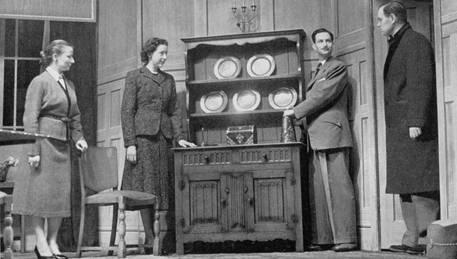
Left to right:—Maureen Dempster, Jean
Boothman,
Arthur Westall, and Peter Gordon
|
|
Our function is somewhat different, and in presenting our
report we must take into account any difficulties which have beset
production, the keenness of the players and the contribution they make to
the social life of the Bank, while striking a happy medium between the
parish-magazine-good-time-was-had-by-all type of journalism and fair and
legitimate comment on the performance of those who have, after all, taken
the public's money and must reasonably expect to hear some comment upon
their efforts. This sounds as though we were leading up to a slashing attack
on someone, but as there are one or two obvious comments which many people
will make, we want to answer them here. Why did the Society, which has a
fairly large number of keen amateur actors, choose for a major production a
play which only used four of them? Why was this particular play chosen? The
fact is that the producer, Mr. Sydney N. Rimmer, had a much more ambitious
production in mind, a period play, which would have used a lot of people,
and much time was wasted before the discovery was made that it couldn’t be
cast. Then, with time running short, the question arose of finding a play
which could be produced fairly quickly and Mr. Rimmer’s choice was this
one. These things are very much a matter of individual taste, and we
personally thought the play was so improbable as to be unreal and that the
task facing the actors was, therefore, very difficult to surmount. Having
said that we are very glad to be able to let ourselves go in praise of
Peter Gordon and Maureen Dempster, on whom the main burden fell. Peter’s
performance as the self-centred, complacent, blase member of the English
aristocracy (surely of another generation than this!) was of a very high
standard. Maureen’s portrayal of a shrew was excellent, just a bit too
excellent for our liking as we know someone like that in real life and so
the humour of it didn't appeal to us. This, of course, is just as striking
a tribute to Maureen’s acting as was the comment of a girl (not in the
Bank) who sat near us:—“I shouldn't like to meet her, she must be a horrid
sort of person.” If we had known the girl, we would have assured her that
no member of the company is held in higher regard and affection than
Maureen. At the same time it is only fair to Arthur Westall to say that her
performance was a little overdone, and the great strength of it made his
task of persuading the audience that he was madly in love with such a shrew
very hard to achieve. Frankly, he did not convince us, but that was partly
the fault of the play itself and partly the producer's fault in having
Maureen's part played with such power. Also, we felt that Arthur himself
was not always entirely happy in the part. At times he was extremely good
and obviously had the audience thoroughly behind him as, for instance, when
he was allowing himself to be ordered around and made to perform certain
menial tasks. When he finally asserted himself, the audience loved it. The
palm for the most finished performance must surely go to Jean Boothman, who
played the part of the friend of the woman played by Maureen. She looked so
nice, her diction was so clear and her sense of fun which keeps bubbling
through combined to present a most pleasing character. It was a really
lovely performance. The parts were very long ones to memorise and there
were commendably few prompts. To conclude, if we were Maureen Dempster, we
would refuse to play any more parts of this sort. She has now had a long
run of parts which call for a display of the less kindly virtues of the
human personality and her ability and experience are quite equal, in our
opinion, to mellower parts. There is no need to ‘type’ her.
|

Intellectual Property Rights ©
Martins Bank Archive Collections 1988 to date.
|


